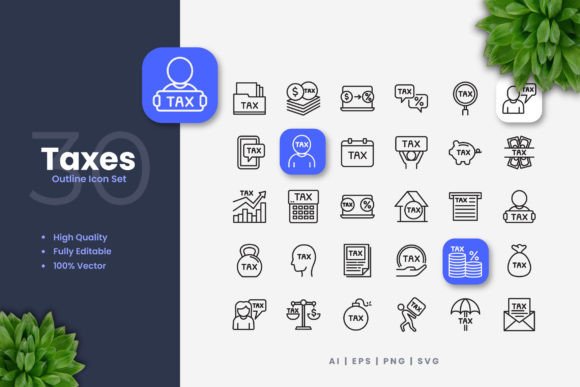
A Comprehensive Guide to Taxes Icons
For designers, developers, and content creators, effective visual communication is paramount. When dealing with complex topics like finance, taxation, or accounting, clarity becomes even more critical. A well-designed icon set can bridge the gap between abstract concepts and user understanding. This article evaluates a specific visual asset: a collection known as Taxes Icons. We will explore its characteristics, practical applications, and key considerations to help you determine if it aligns with your project requirements.
What Are Taxes Icons?
Taxes Icons refers to a curated set of graphic symbols specifically designed to represent concepts related to taxation, finance, and accounting. This includes icons for documents like tax returns, symbols for actions like filing or calculating, and representations of entities like government agencies or financial institutions. The set described in this context emphasizes a simple and clean design philosophy, making it versatile for various media. It is provided as a vector graphic package, meaning the icons are built from mathematical paths rather than pixels, which allows for infinite scalability without loss of quality.
Core Features and Technical Specifications
The technical offering of this Taxes Icons set is a significant part of its value proposition. It is described as containing 100 unique vector icons, each fully customizable. The editable stroke feature means the line weight of the icons can be adjusted to match different design hierarchies or visual styles. The included file formats are crucial for practical use:
- Source File (Ai): The native Adobe Illustrator file allows for deep editing within a standard vector software environment.
- EPS Version 10: An older but widely compatible vector format, useful for legacy systems or certain print workflows.
- SVG File: Scalable Vector Graphics are essential for modern web development, as they can be directly implemented in code, scaled, and often manipulated via CSS.
- PNG Transparency: Providing rasterized PNG files with transparent backgrounds offers immediate usability for digital applications where vector editing isn't needed.
- Readme.txt: A simple documentation file typically contains usage instructions or licensing information.
A notable point is that preview mockups are not included, meaning the purchase is for the raw icon assets themselves, not pre-made presentations of them.
The Advantage of Vector Format
The vector nature of these Taxes Icons is its primary functional benefit. Using software like Adobe Illustrator or CorelDRAW, a user can resize any icon to any dimension—from a tiny mobile app button to a large poster—while maintaining sharp edges. Changing color is a simple process of selecting the shape and applying a new fill, enabling quick adaptation to any brand color palette. The ability to edit stroke weight helps the icons integrate seamlessly into designs that use varying line thicknesses for visual consistency.
Potential Applications and Audience Fit
The simple and clean design of these Taxes Icons makes them suitable for a broad range of applications. This versatility is a key reason for interest.
- Digital Interfaces: Websites and mobile apps dealing with tax software, financial advisement, or accounting services can use these icons for navigation, feature illustration, and enhancing user experience.
- Educational and Informational Content: Books, e-books, infographics, and blog posts aiming to explain tax concepts can integrate these icons to break down complex information visually.
- Marketing and Print Material: Flyers, banners, posters, and social media graphics for firms like tax consultancies, law offices, or financial institutions can benefit from a consistent, professional set of symbols.
The audience likely to find this product useful includes graphic designers working on finance-related projects, UX/UI designers building financial apps, content creators in the business and finance niche, and marketing professionals at firms in the tax and accounting sector. It serves those who need a ready-made, cohesive set of symbols to accelerate their workflow without commissioning custom illustrations.
Benefits, Tradeoffs, and Considerations
When evaluating this Taxes Icons set, it is important to weigh its benefits against potential limitations and project-specific needs.
Benefits
- Time Efficiency: Access to 100 pre-designed icons eliminates the time cost of creating each symbol from scratch.
- Design Consistency: A unified set ensures a professional and coherent visual language across all project materials.
- Flexibility: Vector editing provides extensive control over size, color, and detail to match existing design systems.
- Multi-Format Support: The inclusion of SVG, PNG, and source files covers most common use cases from web development to print.
Tradeoffs and Considerations
- Style Specificity: The "simple and clean" design style may not suit projects requiring a highly ornate, textured, or hand-drawn aesthetic.
- Concept Scope: The set focuses on tax-related concepts. If your project requires a broader range of general finance or business icons beyond taxation, you may need to supplement this set.
- Software Dependency: Full customization requires access and basic proficiency in vector software like Illustrator. The PNG files offer a non-editable alternative, but the core value of customization is tied to the vector source files.
- No Mockups: As noted, preview mockups are not included. You are purchasing the components, not example layouts, which requires you to invest time in integration.
Decision-Making Insights: Is It a Strong Fit?
Determining whether this Taxes Icons package aligns with your goals depends on a few practical questions.
Situations where it may be a strong fit: You are working on a project with a clear focus on taxation, finance, or accounting. Your design guidelines favor minimalist, modern, and clean visuals. You have the capability (or a team member with the capability) to use vector editing software to adapt the icons. Your project spans multiple media types (web, print, digital) where the different file formats would be directly useful. You prioritize having a complete, consistent set over creating unique, bespoke icons for each need.
Situations where alternatives may be worth considering: If your project requires icons for a vastly broader theme than just taxation, a more general business or finance icon pack might be more economical. If your visual style is distinctly illustrative, cartoonish, or uses complex gradients and textures, this simple set may not integrate well. If you have no means or intention to edit vector files and only need static PNGs at a fixed size, you might explore cheaper or more specialized raster image options. Finally, if your budget allows and brand identity demands it, commissioning completely original custom icons would provide unique assets tailored exactly to your messaging.
Evaluating Against Your Needs
A practical step is to audit your current or upcoming project. List the specific icon concepts you require (e.g., "tax form," "calculator," "government building," "coin"). Check if the 100 icons in this Taxes Icons set likely cover those needs. Assess your team's technical skill with vector tools. Review your brand's visual style guide to see if "simple and clean" aligns with it. By answering these questions, you can move from a generic interest in icons to a specific evaluation of this product's utility for your situation.
Conclusion
The Taxes Icons set presents a focused solution for visual communication in the tax and finance domain. Its value lies in the combination of topic-specific design, vector-based customization, and multi-format delivery. For individuals and teams whose projects operate within this niche and favor a clean aesthetic, it can be a resource that enhances professionalism and saves development time. However, its suitability is not universal. Carefully consider the scope of your icon needs, your design style, and your technical workflow. By doing so, you can make an informed decision on whether this package serves as a helpful asset or if exploring alternative resources would be a better path to achieving your project's visual goals.